

News
Welcome to the Cedar's Revolution Website
 Sunday June 10, 2007 DAY 22
Nahr Al-Baled
Sunday June 10, 2007 DAY 22
Nahr Al-Baled
 Sunni
cleric Fathi Yakan declared Sunday collapse of mediation efforts to find a
peaceful resolution to the Nahr al-Bared confrontation between the Lebanese army
and Fatah al-Islam militants.
Sunni
cleric Fathi Yakan declared Sunday collapse of mediation efforts to find a
peaceful resolution to the Nahr al-Bared confrontation between the Lebanese army
and Fatah al-Islam militants.
He said the conflict was now in the hands of
al-Qaida with which he had no contact.
"The issue is now very complicated
after the dossier has been handed over (by Fatah al-Islam) to al-Qaida," Yakan
said."We have reached a dead-end."
Syrian Attempts To Divide the Nation FAIL!
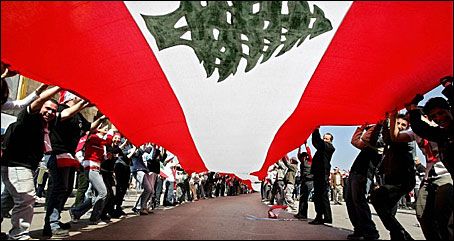
Lebanese WorldWide United with This Army and This Democratically Elected Government facing the challenges of Nahr Al-Baled
Lebanese Army Defending the Nation against the latest round of Intimidation Plots sewn by this Syrian Regime, Lebanese Worldwide Rally in a Support of Unity around this Lebanese Army and this Democratically Elected Government.
- Analysis The Syrian-Jihadi "highway" in Lebanon - by Walid Phares
- New Today's NEWS [
LINK ] (wait for it to load)
- New Updated Blog [ Cedars Revolution
Blog
]
- New UN Sec Council Resolution
1757 [ .pdf ]
- New UN 1757 Meeting Record [ .pdf
]

A poster with a picture of killed Lebanese soldier Mahmoud Rahmoun is seen through waved Lebanese flags during a rally supporting the Lebanese army in the north city of Tripoli, Lebanon Sunday, June 10, 2007. 52 soldiers have been killed in Tripoli and the Palestinian refugee camp of Nahr el-Bared during the Lebanese army assault on Fatah Islam militants that began May 20, the worst internal violence in Lebanon since the 1975-90 civil war. (AP Photo/Nasser Nasser)
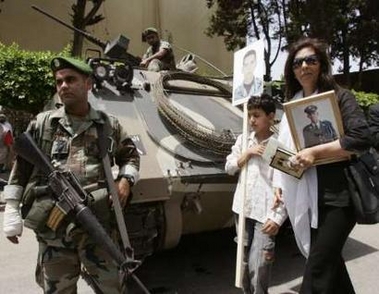
A Lebanese woman carrying a photograph of her husband who was killed in clashes with the Fatah al-Islam group walks with her son during a rally supporting the Lebanese army in its fight against the Fatah al-Islam group, in Tripoli, northern Lebanon, June 10, 2007. Fighting between the Lebanese army and al Qaeda-inspired militants in north Lebanon entered its fourth week on Sunday and five soldiers died from wounds sustained in heavy battles the previous day. REUTERS/Jamal Saidi (LEBANON)
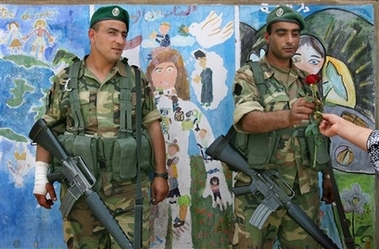
A woman gives a rose to a soldier during a rally supporting the Lebanese army in the north city of Tripoli, Lebanon Sunday, June 10, 2007. 52 soldiers have been killed in Tripoli and the Palestinian refugee camp of Nahr el-Bared during the Lebanese army assault on Fatah Islam militants that began May 20, the worst internal violence in Lebanon since the 1975-90 civil war. (AP Photo/Nasser Nasser)
Bush says Syria should stop disrupting Lebanon
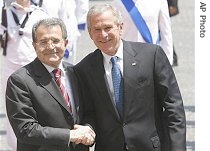 |
| George Bush, (r), shakes hands with Italian PM Romano Prodi upon arrival at Chigi Palace in Rome, 09 Jun 2007 |
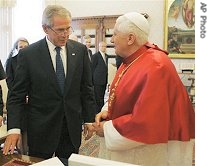 |
| President George W. Bush talks with Pope Benedict XVI, 09 Jun 2007 |
ROME (Reuters) - President George W. Bush said on Saturday that Syria should stop disrupting the Lebanese government of Prime Minister Fouad Siniora.
"It's very important that foreign influences like that of Syria not be continually disrupting the Sinora government," Bush said during a news conference with Italian Prime Minister Romano Prodi in Rome.
Some
ammunition dumps of Fatah al-Islam militants were blown up in the army shelling
Saturday, state-run National News Agency reported.
Three
Lebanese army soldiers were killed and a dozen wounded by Fatah al-Islam snipers
on Saturday, a military spokesman said.
Fatah
al-Islam militants besieged inside the northern refugee camp of Nahr al-Bared
have booby trapped corpses as well as buildings in order to inflict as many
casualties as possible among Lebanese soldiers determined to crush the
terrorists, state-run Tele Liban said.
News of
the booby trapping came following the army's massive ground offensive into Nahr
al-Bared in a bid to finish off the terrorists.
By early
afternoon, troops were able to destroy several buildings where militants were
believed to be hiding, causing an a large number of fatalities, NNA said.
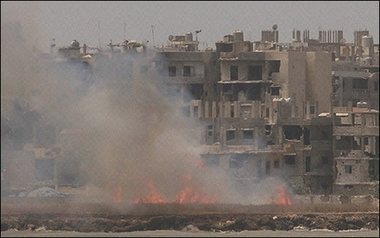
Smoke from artillery and tank shelling rises from the Nahr al-Bared Palestinian refugee camp in northern Lebanon, 08 June 2007. Three Lebanese soldiers were killed in new clashes with Islamist militants holed up in a Palestinian refugee camp as mediators announced a setback to efforts to broker a peaceful end to the 21-day siege.(AFP/Ramzi Haidar)
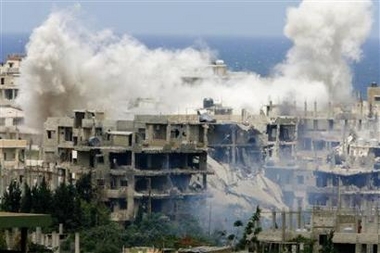
Smoke from artillery and tank shelling rises from the destructed Palestinian Nahr al-Bared refugee camp in northern Lebanon, June 7, 2007. (Jerry Lampen/Reuters)
------------------------------
Friday June 8, 2007
A cluster
bomb left over from last summer's Israel-Hizbullah war detonated east of the
southern port city of Tyre late Friday.
No casualties were reported in the
explosion of the device in Howsh area, four kilometers east of
Tyre.
French
Foreign Minister Bernard Kouchner on Friday invited Lebanese political
factions to informal talks in France to "encourage resumption of
dialogue" among
them.
Heavy fighting
flared anew Friday between Lebanese troops and Fatah al-Islam militants at the
northern refugee camp of Nahr al-Bared amid reports that the army has stepped up
its ground offensive into the beleaguered shantytown.
Future TV footage
showed clouds of white smoke billowing from the stricken camp as troops moved
into Nahr al-Bared behind massive artillery barrages.
FTV said gunbattles,
which broke out around 8 a.m., were concentrated around the Cooperative
building, where Fatah al-Islam leader Shaker Absi and his deputy known by his
nom de guerre of Abu Hureira are believed to be hiding.
Thursday June 7, 2007
An
explosion ripped through the industrial district of Zouk Mosbeh north of Beirut
Thursday night, LBCI TV reported.
TV footage showed firefighters battling to
put down raging fires from the 9:20 pm blast. A car was seen badly damaged in
the area.
LBCI said two workers were injured from the blast which targeted a
warehouse of oxygen cylinders.
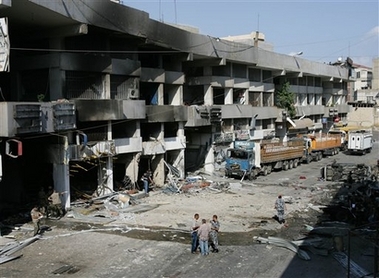
Lebanese investigators, inspect the scene in front of a damaged building, a day after a bomb exploded at an industrial area in Zouk Mousbeh, about 20 kilometers (12 miles) northeast of Beirut and near the Christian town of Jounieh, Lebanon, Friday June 8, 2007. A bomb went off near a Christian town north of Beirut on Thursday killing at least one man and wounding three others, in the latest string of explosions that have shaken Lebanon since fighting erupted between army troops and Islamic militants in a northern refugee camp three weeks ago.(AP Photo/Hussein Malla)
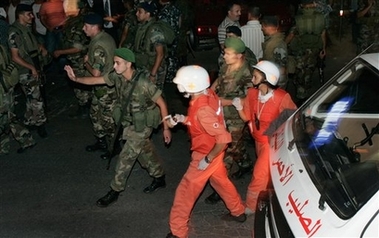
Rescue workers and an ambulance, right, attend the scene after a
bomb went off in Zouk Mousbeh, about 20 kilometers (12 miles) northeast of
Beirut and near the Christian town of Jounieh, in Lebanon Thursday, June 7,
2007. A bomb went off near a Christian town north of Beirut on Thursday, in the
latest string of explosions that have shaken Lebanon since fighting erupted
between army troops and Islamic militants in a northern refugee camp three weeks
ago. (AP Photo/Ben Curtis)
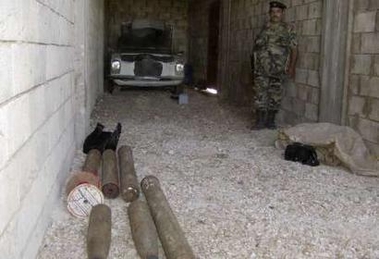
A Lebanese soldier stands guard near missiles found in a car in the Bar Elias village, eastern Lebanon, June 7, 2007. Lebanese security forces found three car bombs in eastern Lebanon on Thursday, a day after they arrested three suspected al Qaeda members in possession of weapons and explosives, security sources said. REUTERS/Afif Dyab (LEBANON)
Wednesday June 6, 2007
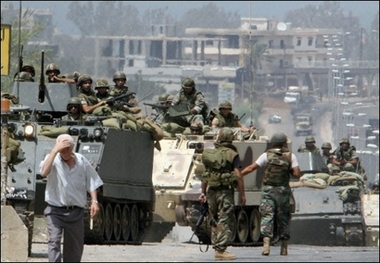
Lebanese soldiers secure the outskirts of the Palestinian refugee camp of Nahr al-Bared in northern Lebanon, 06 June 2007. Islamist militants locked in a standoff with the Lebanese army have threatened to widen attacks as tanks and helicopter gunships pounded their strongholds inside an impoverished Palestinian refugee camp.(AFP/Ramzi Haidar)
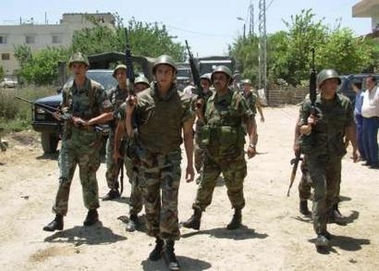
Lebanese soldiers patrol a street to secure the area where three car bombs were found in the Bar Elias village, eastern Lebanon June 7, 2007. Lebanese security forces found three car bombs in eastern Lebanon on Thursday, a day after they arrested three suspected al Qaeda members in possession of weapons and explosives, security sources said. REUTERS/Afif Dyab (LEBANON)
Tuesday June 5, 2007

Memorandum for the Secretary of Transportation
June 5, 2007
SUBJECT: Partial Resumption of Travel to Lebanon to Promote Peace and Security
By virtue of the authority vested in me by 49 U.S.C. 40106(b) and for the purpose of promoting peace and security in Lebanon, I hereby determine that the prohibition of transportation services to Lebanon established by Presidential Determination 85-14 of July 1, 1985, as amended by Presidential Determination 92-41 of August 17, 1992, and Presidential Determination 98-32 of June 19, 1998, is hereby further amended to permit U.S. air carriers under contract to the United States Government to engage in foreign air transportation to and from Lebanon of passengers, including U.S. and non-U.S. citizens, and their accompanying baggage; of goods for humanitarian purposes; and of any other cargo or materiel.
All other prohibitions set forth in the above-referenced Presidential determinations remain in effect.
You are directed to implement this determination immediately.
You are authorized and directed to publish this determination in the Federal Register.
GEORGE W. BUSH
U.S. President Bush
lifted a ban on air traffic to Lebanon imposed since the 1985 hijacking of a TWA
jetliner to Beirut.
A press release issued by the White House said Bush was determined that
the "prohibition of transportation services to Lebanon … is
herby further amended to permit U.S. air carriers under contract to the
United States Government to engage in foreign air transportation to and
from Lebanon of passengers, including U.S. and non-U.S.
citizens."
Lebanese troops seized a truckload
of weapons coming from Syria, the daily An Nahar reported Wednesday.
It
said an army checkpoint at Dors in east Lebanon's Bekaa valley arrested
the truck driver after trying to
escape.
Security
officials said the truckload of weapons seized by the Lebanese army late Tuesday
near Baalbek belonged to Hizbullah.
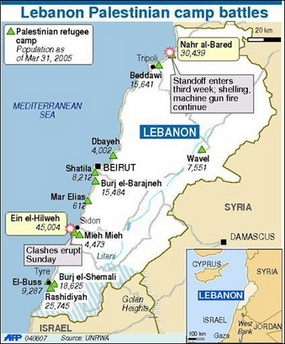
Map of Lebanon locating the Palestinian refugee camps of Nahr al-Bared, where deadly fighting between government troops and Islamic militants entered its third week, and Ein al-Helweh, where new clashes erupted Sunday.(AFP/Graphic/Martin Megino)
Monday June 4, 2007

A Lebanese investigator checks the site where a bomb exploded near an empty passenger bus, east of Beirut, Lebanon Monday, June 4, 2007. A bomb exploded in an empty passenger bus parked in a Christian neighborhood east of Beirut Monday, injuring 10 passers-by, a senior security official reported. Lebanon has seen a string of bomb explosions in and around Beirut since clashes between Fatah Islam militants and the Lebanese army began May 20. (AP Photo/Grace Kassab)
Alawite
legislator Mustafa Ali al-Hussein from north Lebanon's Akkar province announced
he was quitting the March 14 camp.
Tensions
were running high in the refugee camps of Rashidiyeh and Borj al-Shamali near
the southernmost port city of Tyre, state-run National News Agency (NNA)
reported Monday.
It said militants from the mainstream Fatah movement and
other allied factions have kept an all-night vigil over the two camps.
NNA said sporadic clashes continued through the night and Monday morning between
Lebanese troops and Fatah al-Islam militants holding out inside the northern
refugee camp of Nahr al-Bared.
NNA
confirmed that Fatah al-Islam deputy commander Abu Hureira was injured, while
the personal bodyguard of the group's leader Shaker Absi, who is known by his
nom de guerre of Abu Aisha, was killed in the Nahr al-Bared fighting.
It said the
main road linking Akkar with the rest of north Lebanon was open for
traffic.
The United
States is considering providing the Lebanese Army with more military aid needed
in the fight against Fatah al-Islam and other terrorists.
A powerful
blast echoed across the northern-coastal sector of the Metin Province
near
Beirut.
A powerful
blast ripped through a bus parked near a business center in east Bedirut's Sad
Bushriyeh district wounding at least seven pedestrians and inflicting damage.
------------------------------
Sunday June 3, 2007
- Breaking Analysis - by Dr. Walid Phares
The Syrian-Jihadi "highway" in
Lebanon
by Walid Phares, June 3, 2007
World Defense Review
columnist
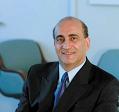 A curious "debate"
is growing rapidly among a number of Western-based analysts about the
"impossibility" of the existence of Syrian Jihadi-Salafist links. More
particularly, some analysts went to the extent of describing the existence of
links between the Syrian Mukhabarat and the group Fatah al Islam operating in
North Lebanon as "hazy."
A curious "debate"
is growing rapidly among a number of Western-based analysts about the
"impossibility" of the existence of Syrian Jihadi-Salafist links. More
particularly, some analysts went to the extent of describing the existence of
links between the Syrian Mukhabarat and the group Fatah al Islam operating in
North Lebanon as "hazy."
Ironically this mounting trend meets the current Syrian diplomatic and media campaign halfway, as Damascus is deploying extensive efforts to deny "any link whatsoever" with Fatah al Islam. In fact, Assad shut down the passage points in northern Lebanon just a few hours after the Jihadists began slaughtering the Lebanese soldiers. Interestingly enough Syria has not closed entry checkpoints to Lebanon since 1976, even though Tripoli's skies were burning during many battles between militias and factions.
Was Assad too fast in denying his backing of Fatah al Islam, as with his instant denial of his regime's role in the Hariri assassination?
We'll come back to this matter later. But first let me examine the arguments in the claim stating that Fatah al Islam is al Qaeda, and therefore it cannot be backed by the Syrian regime.
"Intoxication"
Intelligence and Counterterrorism experts are familiar with the weapon known as "intox" from the root word intoxication. It is a form of deception used by powers throughout history and developed as a special skill by the Soviet KGB during the Cold war. Later on various Jihadi networks, both Iranian and Salafist, have improved this method via the use of Khid'a (deception) and the historically rooted concept of Taqiya (dissimulation tactic).
The bottom line is that regimes and organizations, Islamist and ultra-nationalists (i.e. not sanctioned by domestic checks and balances) can use all deceptions possible and don't have to be transparent. In the War on Terror or the Terror War against Democracies, do not expect — naively — these radicals to tell you the real story. Hence do not expect either the Syrian regime to declare that it is supporting Fatah al Islam at this point, or expect the latter to declare that they are coordinating with Damascus as they are announcing they have pledged to al Qaeda. Reading short of this complex reality would only mean that you have been the victim of "intox," the enemy's Khid'a at its best.
Assad regime's History
To those who cannot fathom how a Baathist secular — and socialist — regime engags in alliances with Islamist forces, fights them, befriend one and represses another, just review the very dense history of Hafez Assad between 1970 and 2000, and the short but bloody history of his son Bashar from 2000 until 2007.
For 37 years the Assad dynasty practiced Taqiya and Khid'a as well as cross-ideological alliances. The regime supported the PLO between 1970 and 1976, before Assad ordered the bloody conflict with Arafat in 1976. Briefly claiming coordination with Right wing Christian parties in 1976-1977, Assad bombed the PLO in 1978. Then using Amal against the Palestinians, the regime supported its own "Palestinian" factions.
Allying himself with Iran and Hizbollah in 1982, the regime wanted to contain Hizbollah in Beirut in 1986. Fighting against the Lebanese (Christian) Forces since the 1970s, the Syrians backed a faction among them (Elie Hobeika) in 1986, fought another (Samir Geagea) until 1989, claimed to befriend the latter for a short time before ordering oppression of their partisans as of 1993.
Assad fought the Muslim Brotherhood in Syria, but funded the Islamists in Lebanon and Palestine. His regime claimed it was secular while becoming the single strategic ally of Iran's Islamist elite. In Lebanon and after the withdrawal of the bulk of his army, Bashar kept his entire apparatus: from Shia Hizbollah and Amal, some Druse factions, and a few Christian warlords, to a large range of pro-Sunni politicians and groupings. How can the Assad intelligence net achieve this?
That is another story about the Baathist sophistication. And as of spring 2005, a main former anti-Syrian politician was added to the panoply of Syrian (and Iranian) political assets in the country: General Michel Aoun. However, perhaps the most advantageous "grabs" by the Baathist Mukhabarat were Sunni Islamists, who should have been ideologically on the other side of Assad, but who, with the attraction of a "deity" — dollars and power — have agreed to line up with a Taghut (unjust ruler in Jihadi literature).
Indeed, as of the early 1990s, Assad, the father, succeeded in recruiting Islamic (Sunni) Fundamentalists. Obviously the prime against-nature alliance was with Hamas and Islamic Jihad, both Sunni Islamists. Once that was "accomplished," other models were possible. Hence, the next wave of Sunni Islamists to be "recruited" by the Syrian intelligence were precisely those based in Tripoli and Sidon in Lebanon, for example Harakat al Tawheed of Shaaban and the Gama'a al Islamiya. And once Syrian intelligence can penetrate that far in Sunni radical land, it can naturally fund those who will at some point "join" al Qaeda.
Years later, the Assad junta's efforts paid off. While many in the realm of Western logic cannot absorb it, the fact is that Syrian intelligence not only has a strategic relationship with Islamic Fundamentalists who are fighting a same enemy, but also has a control process over some groups who, while being attracted ideologically to al Qaeda, are enjoying the checks of the Assad regime. Hence, the odd situation of Fatah al Islam in their affiliation with the ideology of al Qaeda (contradictive with the Baath) and their acceptance of Syrian logistical (and binding) aid.
Jihadi tactical history
One has also to have a solid understanding of Jihadi-Salafi tactical history. This type of movement is indeed very rigid on ideology. Its attitude towards the so-called Kuffar (infidels) is unshakeable: Jews, Christians, Hindus, Muslim Shiites and even Sunni "apostates" are ranked as enemy.
But the Salafi Jihadists have often used their enemies, accepted their donations and produced all the reasons for this behavior. If Wahabi Islamists have welcomed strategic assistance from American infidels in Afghanistan in the 1980s they surely would accept weapons and money from the region's Baathists. Western "experts" shouldn't have an existential crisis if the Jihadists divert a little from the books they print. Yes, even the Salafi Jihadists can be "tactical." In Tripoli's case, not only Fatah al Islam was encouraged by the Syrian intelligence, but a number of its leadership were jailed then freed by Damascus .
Stakes for Bashar's regime
Another component of the "unnatural" cooperation between the Syrian regime and a more than one Jihadi group in Lebanon is the urgency for Bashar. Hafez Assad used Islamist groups in Lebanon and in Palestine during the 1980s and the 1990s for very specific reasons: control of the game with Israel and with the opponents of the Baath in Lebanon.
Bashar's intelligence is using them for a higher stake: to protect the Syrian regime from collapse by ordering the crumbling of the Lebanese Government before. It centers on the Hariri UN Court and on the implementation of UNSCR 1559. Only seasoned readers of Assad politics can see it as clearly as a grand plan.
The Syrian game plan
It is always beneficial for commentators and analysts to look at developments involving terrorism, from historical and geopolitical angles. When Fatah al Islam began the attacks against the Lebanese soldiers it wasn't because of a bank robbery. The group declared last November the purpose of enflaming Tripoli, and with it a "northern front" against the Seniora Government. Reading it otherwise is a short sight watching of unfolding events.
The road to the battle of Tripoli began in April of 2005, when Bashar Assad delivered a speech in Damascus in which he declared his intention to withdraw his army from Lebanon under American, French and international pressures. A thorough reading at the time told all those connoisseurs of the Baathist regime that he was planning on pulling out the "first army" (the regular troops and tanks), but he had instructed the "second army, " (Hezbollah, the pro-Syrian militias, and the Terrorists implanted within Palestinian camps) to take the offensive.
From July to December 2005, a number of Cedars Revolution leaders were savagely assassinated and bombs targeted several areas. From January to June 2006, while the March 14 (anti-Syrian) politicians were lured into discussions with Hezbollah, the Syro-Iranians introduced weapons and terrorists through the Bekaa borders with Syria . By July, Hezbollah waged a war against Israel. As of October 2006, Nasrallah waged an urban war against the Seniora Government: A Minister was assassinated and downtown Beirut was occupied.
From January 2007 until now the Jihadi card has been used. This is the strategic context in which Fatah al Islam operates today: engaging the Lebanese Army in several spots, starting with Tripoli. In short, the Assad regime has no doctrinal ethics as many fooled experts believe in the West. The Syrian regime would sleep with any enemy and use all assets to reach its goal.
Bashar's war room can assassinate Lebanese politicians with the agents of the neo-Nazi SSNP, set off bombs and suppress Shiites intellectuals with Hezbollah expertise, besiege the Lebanese Church with the help of Christian feudals such as Soleiman Frangieh, disorient the Maronite masses with turncoat Michel Aoun, penetrate the Sunni community with "funded" Salafi Jihadists and thrust into the Druze clan with "paid" operatives.: And as this Terrorist architecture is set up in Lebanon, another span of "Assad Labyrinths" lures outside powers into the game.
The Syrian regime, while ally with the Mullahcracy in Tehran, tells the Americans it could do business with them; and, as Bashar instructs his operatives overseas to blast the Saudi regime, he flies over to Riyadh to assure them of his friendship. Hence, a regime that can master such a diabolical engineering can easily recruit and have remote control over the little Fatah al Islam and place it in Assad's vast tool-set in Lebanon and the region.
Fatah al Islam: Opportunistic Jihadi Hybrid
To understand the nature of Fatah al Islam, one has to cross several layers of distinctions — first between an "official chapter" of the Bin Laden organization and the other types. Shaker al Absi's group is not a chapter, yet. Then one must distinguish between those Jihadist entities fully independent from regimes and intelligence services and those "implicated" in some ways.
Fatah al Islam is Salafi Jihadist, regards Bin Laden as an ideological leader, but also happens to be on the receiving end of Assad's payroll. In short, not all Jihadi groups are perfect. So, at the end of the day, the Nahr al Bared based Salafi Terrorists are Jihadi in nature and tied to Syrian intelligence per needs. They could be seen as "Opportunistic Hybrid Jihadis." They can adapt to future situation in the future, if they survive as an organized networks.
Some Terrorism commentators in the West and in the US spoke of an "elusive Fatah al Islam." Unfamiliar with the Levantine nature of the phenomenon, those commentators still struggle with what they describe as "speculation" over the group's "real motives," as if they haven't captured the equation behind Fatah al Islam. These commentators base their inability to define the group on classical ethnocentric errors in analysis. First, they conclude that this group can't have ties to Damascus because the Syrian regime executed four members of the group. Ironically, the news came from the Syrian intelligence itself, which means that the Assad regime can go as far as killing operatives to intimidate the rest of the group, and on top of it, "sell" the news to the world as an "an anti al Qaeda" activity, which by the way would be bought by US officials.
It would take a world, and many books to explain the twisted — but successful — mind of the regime in Damascus. "Killing" Islamists at the hand of the Syrian soldiers is another form of taming wild activities and raining in. And for those who can't fathom this behavior, just remember how in 1987, Syrian special forces slaughtered a number of Hezbollah fighters in Beirut even when Syrian intelligence was coordinating with Iran. Each blood shed, has a specific reason in this business.
The analysts who can't absorb the Syrian-Fatah al Islam form of cooperation often cite statements made by al Qaeda in Iraq's past commander attacking the Shiites, and hence the Alawite regime. But what escapes commentators is that theological and ideological principles can be selectively applied, so that strategic goals can be reached. The "principles" are never forgotten but the roads to attain them can be full of blind spots. And just as a reminder, it was Ayman Zawahiri, al Qaeda's number two, who asked Zarqawi to forget about the Shiia apostates in Iraq until time opportune comes. So, statements made by a few hot-headed Jihadi commanders in Iraq won't stop pragmatic Jihadists in Lebanon from receiving aid from Alawi apostates.
There is something called al Darura that escapes many on-the-spot analysts as they navigate in the highly intricate world of the Jihadists: it translates into "necessity." If it is deemed necessary by the Emir of a group to use the goodies of an infidel party to fight the other infidel party, it will be selected comfortably. Remember how the Wahabis of the 1980s used all resources from a far-Infidel power, the United States, to fight a close infidel enemy, the Soviet Union , and learn from that example.
Seeing beyond "Intox"
Once more, the unseen tie between the Assad regime and the Terrorist Jihadi groups is in the center of international and US scrutiny. The Iraq debate in 2002-2003 fell short of reading the type of "links" that existed between the Baathist regime of Saddam Hussein and al Qaeda. Most observers missed the actual state of those relationships that existed. From my reading of 42 pages of Iraqi intelligence (in Arabic) from the 1992-1994 years, I saw clearly how both sides were exploring the potentials. From my previous observation of Saddam's symbolic metamorphosis in the 1990s towards a higher use of Islamist symbols I understood that he wanted to have this dimension at his disposal, without changing his regime's doctrine deeply.
It was the level of darura again. But in Assad's case, the darura is high: The regime depends on arming Jihadists (even if they could sting you later) and sending them off to Iraq , and now to Lebanon.
The Salafi Jihadists are like a dangerous chemical weapon that you'd want to throw on your foe while knowing it can come back at you. But guess what? It is more important for the Assad regime to crumble the Seniora Government now and crush future Salafi backfiring later. The Syrian intelligence is expert at eliminating their past tools, even if they were Syrians as well.
What the expert community in the West and in the US must do is to see beyond the analytical "intoxication" unleashed by the regimes and organizations in the region, and expanded by their advocates in the West. Just keep in mind that the Iranian-Syrian axis is spending millions of dollars on one of the most sophisticated PR campaigns aiming at blurring the vision of their foes.
If you investigate thoroughly the grapevines, you'd be able to find out that most of the "arguments" made in our public space about the types of relationships that "can" exist, and those that "shouldn't," are manufactured in Tehran and Damascus. Subconsciously or not, many in the West parrot the claims made by Middle East dictatorships, Jihadi strategists and al Jazeera commentators, unfortunately weakening democracies' stand in the War of Ideas.
At the end of the day, as I try to argue in my latest book, the ultimate strategic goal of the enemies is to force the West to see wrongly and act accordingly. In the case of Fatah al Islam's battling in Tripoli, the aim of the Syro-Iranian propagandists is to camouflage what is obvious for as long and thick as they can: That the Syrian regime not only has established ties to some Jihadist groups, but has in fact paved a "highway" in their direction, with the goal of using them as one of the defense lines for the regime. Hence, it is up to the public and the policy makers in the West to thrust through the deceptive "intoxication" tactic by Damascus and Tehran, to see clearer, and only then, to act accordingly.
Dr Walid Phares is a senior fellow with the Foundation for the Defense of Democracies (FDD) in Washington, D.C., and director of the Future Terrorism Project of the FDD. He is a visiting fellow with the European Foundation for Democracy in Brussels. His most recent books are Future Jihad: Terrorist Strategies against the West (2006) and The War of Ideas: Jihadism against Democracy
Aside from serving on the boards of several national and international think tanks and human rights associations, Dr. Phares has testified before the US Senate Subcommittees on the Middle East and South East Asia, the House Committees on International Relations and Homeland Security and regularly conducts congressional and State Department briefings, and he was the author of the memo that introduced UNSCR 1559 in 2004.
Visit Dr. Phares on the web at walidphares.com
- Breaking News
Three soldiers and two
Palestinian civilians were wounded in the fighting that broke out at dusk Sunday
after a Jund al-Sham militant tossed a hand grenade at an army checkpoint
outside the southern Ein el-Hilweh refugee camp, police said. There
were conflicting reports on whether Fatah al-Islalm's deputy commander, Abu
Hureira, a Lebanese whose real name is Shehab al-Qaddour, was killed in Sunday's
gunbattles in Nahr al-Bared or wounded in his shoulder, Al-Arabiya TV reported.
Correspondent for the state-run National News Agency in north Lebanon
said army troops were in "full control over all axes" to Nahr al-Bared following
heavy confrontations between the military and extremist fighters on Sunday.
NNA said the army advance was part of a plan aimed at tightening the noose on the militants who have been cornered in the operation that began Sunday morning on the camp's Samed, Cooperative and al-Khan neighborhoods.
Meanwhile, Al-Arabiya TV correspondent said in a live report from the
scene of the fighting that Lebanese troops penetrated deep into Nahr al-Bared
and were engaged in "violent building-to-building" battels with Fatah al-Islam
militants around the Cooperative building inside the northern refugee camp.
Earlier, the army denied that the United Nations Interim
Force in Lebanon was helping Lebanese troops in their fight against Fatah
al-Islam militants. Officials
said Sunday that Fatah al-Islam's third-in-command, Naim Deeb Ghali, also known
as Abu Riad, who was known to send fighters to Iraq, was killed in the
gunbattles with Lebanese troops. Fatah Islam's deputy commander, Abu Hureira, a Lebanese whose real name is Shehab al-Qaddour, said that Abu Riad, was killed Friday. Asked if Abu Riad was a senior Fatah al-Islam official, Abu Hureira said, "he is a brother."
LBC
television said the army has rounded up more than 20 militants. (from NAHARNET.COM)
Cedars Revolution Radio Show
In Lebanon and the Middle East Listen to our 1 hour radio show on Radio Al-Machrek
- Sunday June 3rd on 756AM or 99.9FM at 2pm Beirut Local Time
- Sunday June 3rd 2pm [ Internet Link ]
- or Listen Now - ( .mp3 )
This weeks special broadcast:
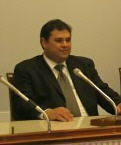
First portion interview in English and Arabic The Director of the World Council for the Cedars Revolution in Beirut Mr. Toni Nissi. In this interiew the Director is asked about the current situation on the ground, UN Res. 1559/Syrian Withdrawal from Lebanon, Why the Lebanese Government refuses to ask the International Community to disarm militias and protect the civil society in Lebanon from Iranian and Syrian manipulations on the Lebanon that is fueling a Civil War, UN Res. 1701.
 Secon d part Commentary by
Eblan Farris on the current events facing Lebanon and what the Lebanese Diaspora
is doing for The Lebanon.
Secon d part Commentary by
Eblan Farris on the current events facing Lebanon and what the Lebanese Diaspora
is doing for The Lebanon.
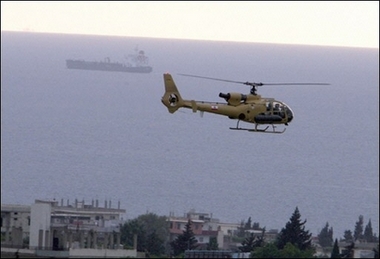
A Lebanese helicopter flies over Tripoli after having fired at targets in the Nahr al-Bared refugee camp. The thud of shells and the rattle of machinegun fire reverberated around a Palestinian camp in Lebanon where fighting erupted again between troops and Islamist gunmen as a deadly standoff entered its third week.(AFP/Ramzi Haidar ) 6/3/07
What is this Man Talking About? Is Iran planning a summer war for the Lebanese?
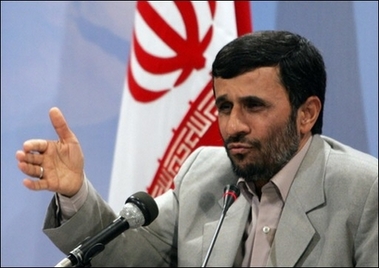
Iranian President Mahmoud Ahmadinejad speaks at a news conference in Tehran, April 2007. On Sunday June 3, 2007 Ahmadinejad said that a countdown has begun that will end with the "destruction" of Israel by the people of Lebanon and Palestine.(AFP/File/Atta Kenare) 6/3/07
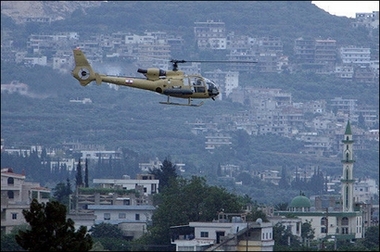
A Lebanese army Gazelle helicopter flies back over the city of Tripoli after having fired at targets at the Nahr al-Bared refugee camp in northern Lebanon. Lebanese Prime Minister Fuad Siniora repeated a warning on Saturday to Islamist militants holed up in a northern refugee camp that they must surrender or be crushed, as intense fighting continued to rage.(AFP/Ramzi Haidar) 6/3/07
[ GOTO Next PAGE ]